… getting that old time religion 1
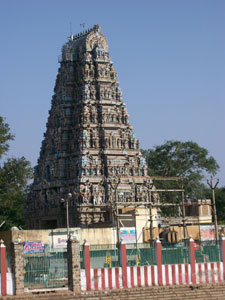 You can’t visit India being hit by that religious assault on the senses, a hindu temple. Of what I have seen so far, the mosques are visually subdued (but noisy, they will do a loud call to prayer on bad loudspeakers at 5:30am) … the Jains are white and minimalist …but the Hindu temples … most of them have some sections in good repair, some bits that are falling apart, some bits that are garish, some that are just inexplicable. This is a shot of Kalareesana, one of the biggest and most active temples in Chennai. The original temple of Kalareesana dates back to about the 5th century or earlier, though it was demolished by the Portugese about 500 years ago, and most of the current temple is about 200 years old. But it is very much a work in progress, with new sections addded, and other parts falling over from neglect …. the main pyramid is decked out in neon tubes, and is really quite mindblowing at night.
 In the south, the general layout is a central pyramid full of statues from myth and legend. Around the pyramid, there are altars to various deities … the main gods are usually represented, Siva, Ganesha, Muruga, the more poplular of the goddesses, the planetary elements.
The larger temples often onto a tank, a large smelly dam, often with a cage like this in the middle. This is another shot of Kalareesana, this taken from the main road in Mylapore.
 A special feature of the Kalareesana tank is the carp feeding. In the wonderfully spiritual and simultaneously grasping way the India has, you can buy stale bus for 10Rs or 100-200 if you look like a tourist … my advice is take a bag, give them 10Rs and stare them down. However you do it, it is worth doing (next time I’m gonna bring my own stale bread). The carp will frenzy to the dropped buns. Usually they’re sliding over each others backs to be the first to get a bin, usually out of the water. The carp are about a foot long, and a feeding frenzy is probably about 2 metres in diameter of fish jumping over each other to get a single stale bun. There is a strange elegance to the way the fish swarm over each other. And in a way, it’s very much how India is. It’s simultaneously beautiful and repulsive, compassionate and cruel. There is a swarm for every little tidbit, nothing is wasted, everything has a place, and if you can stand far enough away to see the big picture it is majestic.
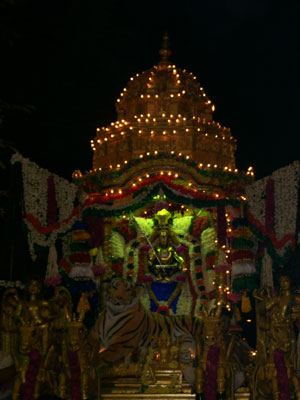
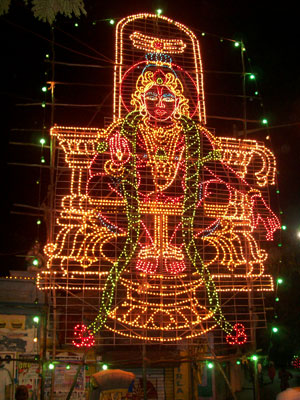 Each temple seems to have its own rituals and ways of celebrating, with many temples maintaining complex ritualistic links with other temples. I spent most of the festival of Ayappar (on of Siva’s sons) at the Katchaleeswarar temple in central Chennai. They had a lot of links to Kerala, so every year brought over a group of drummers from Kerala for the festival, and had this running in alternation with a more standard temple music group featuring tavil and nagaswaram… sometimes together in opposite corners of the temple (but of course both playing their own style). The same temple always started one of their processions from a local Kali temple. Everybody participated (to the extent they felt) in decorating the staturary or procession pieces. The highlight was a procession of statue pf Ayappar with a stuffed tiger on a decked out chariot, covered in flowers, gold painted plaster statues, and one of the local kids. The musical accompaniment fleshed out the Keral drummers and the Nagaswaram players with a Punjabi marching band (drums clarinets and alto saxes). This ran a tour of the block, and about half way round came back to the tank where there was a whopping fireworks display. Other temples on other days would be running golden peacocks and elephants, no rhyme or reason but that it had been done that way for so long.
 What people believe is another matter. In largely secular Chennai, it is as much a cultural thing as it is a spiritual event. Many people are not devout in a literal sense … While most people believe in the god/gods, they are there because it’s who and what they are … it is about who you are (as an Indian) and expressing the essence of that as loudly as possible. Similarly with groups singing of Bhajans … the spiritual aspect of hinduism is as much expressed as a surrender to the moment in this mad collation of rituals, and lushly overbearing imagery and sound.