… film music X files
 On the night before I was scheduled to leave Chennai for Mangalore, I had a fortunately timed call from Nagi, one of the ostentatiously gold draped film music producers I’d met within my first few days in India. Every time we’d tried to connect in the last two months we’d had to cancel, largely because of Nagi’s big gig of the moment, a major film soundtrack. By this stage, I’d given up much hope of Nagi being an interesting connection. Given that it was going to be a hectic day with an evening train to catch, and the thought of a several month break from Chennai in the back of my head, it was certainly odd timing.
But after a few confusing phone calls, and the fact that the driver didn’t speak English that well, the offered lift arrived in Adyar, and whisked me away to the surreal studios of Paul X in Santhome.
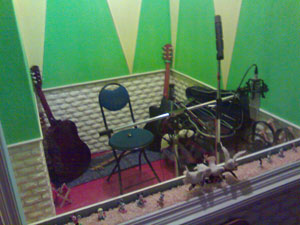
 Paul’s occupied the about half of a flat in Santhome … he lived in the flat below the studio flat. Madly color co-ordinated in green and gold carpet triangles, decorated with model cartoon characters, a few Indian gods, a swathe of plastic flowers, and a good load of music technology… solid outboard gear, compressors and effects processors, a big Mackie desk, latest versions of software (Cubase), quality mikes. The isolation booth was beautifully made, if a touch claustrophobic … by Indian standards this is a very high budget personal studio … apparently funded by a large number of soundtrack gigs by the coterie around Nagi.
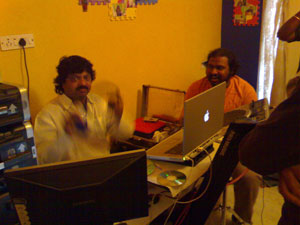 Gear of other co-composers was slung around the rest of the flat … with two complete setups in the next room. Most of the day seemed devoted to rendering individual audio parts on a variety of machines to the hard disk system, preparing it all for a final mixdown. In many ways this is all pretty standard … but the striking thing to me was that it was such a collective project. There were singers, melody writers, lyricists, engineers, string specialists, rhythm programming specialists (Nagi), all contributing bits and pieces to the final product. Most of the coterie had worked together in bands for 10-20 years, so there was a lot of instinctive decision making. At the same time, it was all, in true Indian style, quite anarchic, and yet subtly hieararchical … self organizing, and almost too eclectic.
I’d arrived in time to see a bit of decision making going on around the title sequence … whether to go for mood music, or a more upbeat drumming track. Personally, I would have gone for the funkier percussion, but for some reason I was ommitted from the policy loop.
 In many ways, the music is a lot more striking than the film. “Student” is a shlocky melodrama. The producer (left), whose name I didn’t catch (I think he was introduced as ‘the producer’) doesn’t seem too worried about the shlockiness of the film. This isn’t about art, this is about filling picture theatres, and Indians _love_ shlocky teenage melodramas. It has all the right ingredients. A modern chick, a modern boy, a traditional mum who doesn’t like the boy, a motorbike, a lot of nasty school teachers, some big synchronised dance numbers with crooning pop songs, a bit of hip hop (with big synchronised dancing of course), some toghtly arranged and orchestrated mood music. So while I say for the third time that the film is schlock (except for the big synchronised dance numbers which are wonderful), this is the look of a man who has made a sound investment rather than someone who has paid a shiteload of money for a piece of schlocky teenage crap.
In the end, I was impressed with a lot of what I’d heard of the soundtrack, it covered a lot of stylistic ground, and was a lot funnier than the movie … expecially with the tight synchronisation between on screen action and sound (almost like a silent movie)… this is not uncommon in Indian film soundtracks. The music was sophisticated, and exceptionally well engineered, and I was torn between amusement and amazement. On one hand, there is an extraordinary musical culture here, and it is starting to get a handle on western concepts of production and harmony … but on the other hand, much of the soundtrack is piecemeal (though the pieces are extraordinary), and there is no true fusion between ‘western’ elements and ‘indian’ elements … definitely a product of composition by committee. This is a criticism that a lot of the hard nosed classical buffs have of most film soundtracks. Much of the usage of raga is emotive but simplistic … I think from what I’ve heard I could level the same criticism at the more western elements of ‘the student’ soundtrack. By and large though, I think I had the privilege of seeing the state of art in action, and it is most definitely an evolving culture.